



The cloud provider Infomaniak announces a major evolution of its sovereign Public Cloud, introducing new managed services (Kubernetes and databases), high-performance GPU instances and integrated AI services. Infomaniak’s Public Cloud is entirely designed, operated and controlled in Switzerland, ensuring an unrivalled level of data sovereignty in Europe, with no dependency on extra-European providers or legislation. Powered exclusively by renewable energy and operated in highly energy-efficient data centres, this infrastructure enables organisations to sustainably reduce their environmental footprint and achieve significant cost savings compared to hyperscalers, while maintaining high technical standards and full control over their data.
Managed cloud services to simplify cloud adoption
Until recently, Infomaniak’s Public Cloud primarily relied on OpenStack infrastructure components: compute instances, storage and networking. Over the past year and a half, Infomaniak has developed its own software layers to deliver higher-level managed services, comparable to those offered by major public cloud providers.
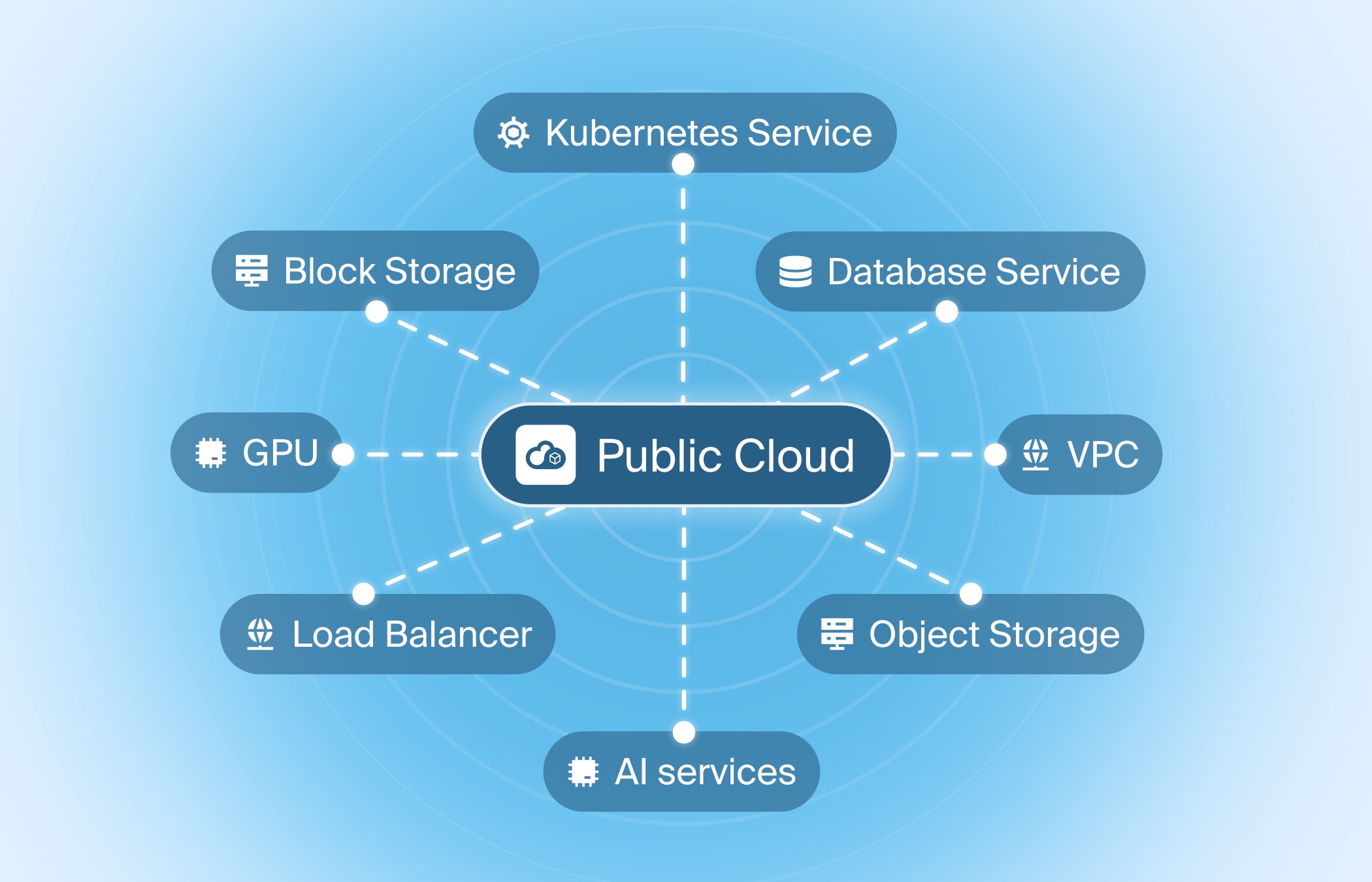
These services include:
- Kubernetes as a Service (KaaS) to orchestrate containerised applications without managing the underlying infrastructure;
- Database as a Service (DBaaS) to run resilient databases with automated backups and maintenance;
- GPU instances for AI and high-performance computing;
- Managed DNS.
All services are available via API, Terraform and directly through Infomaniak’s interface, making adoption straightforward for teams already familiar with modern cloud environments.
Managed Kubernetes with zero-downtime updates
Infomaniak’s managed Kubernetes service enables DevOps teams and developers to deploy and operate containerised applications without worrying about platform maintenance. Infomaniak fully manages the orchestration layer, including cluster creation, high availability, security and updates based on rolling update principles.
A free shared offering is available for testing and small projects, alongside dedicated plans with SLA guarantees, including multiple control plane instances. Application resources remain fully under customer control via Public Cloud worker nodes, with horizontal autoscaling features to automatically adapt capacity to demand.
Resilient, scalable managed databases
With Database as a Service, Infomaniak radically simplifies database operations in its cloud. The service delivers ready-to-use clusters without requiring companies to manage installation, replication, backups or updates. Customers can choose between a single instance without SLA and two- or three-node clusters with increasing SLA levels.
Databases are distributed across independent availability zones, ensuring strong resilience against hardware or network incidents. The service natively includes configurable daily backups, customisable retention, point-in-time recovery and dynamic scaling of capacity and instance count.
GPU and AI with advanced computing capabilities
Infomaniak’s Public Cloud provides direct-access (pass-through) GPU instances, suitable for intensive workloads such as artificial intelligence, scientific computing, data analytics or rendering. Available models include NVIDIA L4, T4 and A2, with A100 and L40S GPUs widely used for running next-generation AI models.
These GPU capabilities integrate natively with Kubernetes environments and Public Cloud instances, enabling end-to-end AI pipelines to be deployed in a sovereign environment.
Infomaniak also offers on-demand AI services via an OpenAI-compatible API, allowing organisations to leverage open-source AI models hosted and executed in Switzerland. These services cover use cases such as document analysis and summarisation, audio transcription, information extraction and embedding AI features into business applications. They can be combined with GPU resources and Kubernetes clusters to build tailored AI solutions without transferring data outside Europe.
A simple, AWS- and Azure-compatible cloud transition
“When an organisation wants to improve the resilience and independence of its IT from the GAFAMs, the Public Cloud is by far the simplest area to address. Unlike migrating collaboration suites or business tools, it does not change end-user habits and allows system administrators to deploy redundant infrastructures using standard technologies,” explains Martial Fol, Head of Infrastructure at Infomaniak.
Thanks to open and standardised technologies, migrating to Infomaniak’s Public Cloud is designed to be smooth, progressive and reversible. Architectures deployed on AWS or Azure can be migrated without major application redesign, while retaining the same DevOps practices, automation tools and security standards.
This shared methodology enables organisations to reduce their dependency on hyperscalers, regain control over their data and costs, and rely on proven industry standards.
Academy and certified partner network
The Swiss cloud provider has also launched the Infomaniak Academy, a certification programme for developers, integrators and partners. At launch, the Academy offers structured learning paths focused on the Public Cloud and kSuite Pro, which brings together all of the company’s productivity applications, ensuring a high level of expertise and best practices.
A network of certified partners is already in place to support organisations throughout their migration to a fully sovereign cloud, from audit and design through to production operations. This approach allows companies to rely on local experts while benefiting from direct support from Infomaniak.
Trial credits to explore the Infomaniak cloud ecosystem
To enable businesses and developers to test its full cloud offering, Infomaniak provides CHF 300 or EUR 300 in cloud credits, valid for three months after activation with a credit card. These credits can be used across the entire Public Cloud, including Kubernetes, Database as a Service, GPU instances and AI services.
A sovereign, sustainable and fully controlled cloud
Infomaniak’s Public Cloud operates exclusively in Swiss data centres, entirely designed, operated and maintained by Infomaniak, with staff based in Switzerland and no outsourcing. All processing, storage and service operations take place on Swiss territory, ensuring strict compliance with GDPR and the Swiss Federal Act on Data Protection (FADP). This full control provides strong guarantees for sensitive sectors such as healthcare, finance, education and public administrations, in a geopolitical context where extraterritorial data access and dependency on non-European infrastructures represent growing risks.
Infomaniak’s infrastructures are powered 100% by renewable energy and designed for maximum energy efficiency. A significant share of the electricity consumed is recovered as heat and fed back into district heating networks, helping to heat thousands of homes. This approach significantly reduces the cloud’s carbon footprint and embeds the infrastructure in a long-term sustainability strategy, both environmentally and economically.
“In a context of increasing geopolitical uncertainty, European companies must be able to rely on high-performance, transparent and locally controlled cloud infrastructures to ensure business continuity and avoid dependence on unilateral decisions taken by other countries,” explains Marc Oehler, CEO of Infomaniak.

Source(s) : Infomaniak Network SA